Contents (11)
What is doping?
Doping is defined as the occurrence of one or more of the anti-doping rule violations set out in Articles 2.1 to 2.11 of the Code.
Under the Code, athletes are responsible for knowing the anti-doping rules and what constitutes a violation. An anti-doping rule violation is not only a “positive test”, which the Code defines as an adverse analytical finding.
Under the World Anti-Doping Code, anti-doping rule violations include:
- presence of a prohibited substance or its metabolites or markers in an athlete’s sample,
- use or attempted use by an athlete of a prohibited substance or a prohibited method,
- evading, refusing or failing to submit to sample collection by an athlete,
- whereabouts failures,
- tampering or attempted tampering with any part of doping control by an athlete or other person,
- possession of a prohibited substance or a prohibited method by an athlete or athlete support person,
- trafficking or attempted trafficking in any prohibited substance or method by an athlete or other person,
- administration or attempted administration of any prohibited substance or method,
- complicity or attempted complicity by an athlete or other person,
- prohibited association by an athlete or other person,
- acts by an athlete or other person to discourage or retaliate against reporting to authorities.
World Anti-Doping Code
The World Anti-Doping Code (the Code) is the core document of the anti-doping system and sets out the rules athletes must follow. Its purpose is to protect the rights of clean athletes. It has been accepted by the Olympic Movement as well as by sports organisations and anti-doping organisations around the world, and it is recognised by more than 170 governments (UNESCO International Convention against Doping in Sport).
Prohibited List
The List of Prohibited Substances and Methods is published by the World Anti-Doping Agency (WADA) and updated at least once a year. The new list usually comes into force on 1 January each year. It distinguishes substances and methods prohibited at all times from substances prohibited in competition only (in most cases during the in-competition period).
Every athlete is responsible for knowing which substances and methods are prohibited.
A substance prohibited at all times must not be used at any time of the year – neither in training nor in competition. If an athlete takes a substance out of competition (when it is not prohibited) but the in-competition doping control (when it is prohibited) is positive, the athlete has committed an anti-doping rule violation.
Prohibited substances can also be found in common medicines such as painkillers and cold and flu remedies. The Slovak Anti-Doping Agency (SADA) has therefore created the online database www.zakazanelatky.sk (in Slovak), where athletes can check whether a medicine contains a prohibited substance.
A leaflet with examples of permitted medicines that athletes may take (sorted by groups of illnesses) is available here: Permitted medicines (in Slovak).
Therapeutic use exemption (TUE)
One of the key principles of anti-doping is to protect the health of athletes.
For medical reasons it may be necessary to take a prohibited substance or use a prohibited method. Under the Code, such a situation can be resolved with a therapeutic use exemption (TUE).
A TUE may be granted only if all of the following criteria are met:
- the athlete has a clearly diagnosed medical condition that requires treatment with a prohibited substance or a prohibited method;
- the therapeutic use of the prohibited substance or prohibited method is highly unlikely to produce any additional enhancement of performance beyond what might be anticipated by a return to the athlete’s normal state of health;
- the prohibited substance or method is an indicated treatment for the medical condition and there is no reasonable permitted therapeutic alternative;
- the necessity to use the prohibited substance or method is not a consequence of prior use (without a TUE) of a substance or method that was prohibited at the time of such use.
International-level and national-level athletes must be aware of another important rule: a TUE must be obtained in advance, not retroactively, except in medical emergencies and exceptional circumstances.
TUEs for national-level athletes are granted by SADA. TUEs for international-level athletes are granted by the relevant international federation. Organisers of the Olympic Games and other major events may also grant TUEs. A TUE granted by SADA at national level is not automatically recognised at international level. If in doubt, contact the international federation or the major event organiser.
More information on the TUE process: https://antidoping.sk/tue/ (in Slovak)
Nutritional supplements
The regulation of nutritional supplements is generally minimal. Supplements sold in health food shops or online should not contain prohibited substances unless they are listed on the label. In recent years, however, a considerable number of positive tests has been attributed to mislabelled or contaminated supplements.
If an athlete takes a supplement containing a prohibited substance that results in an adverse analytical finding, the athlete cannot defend themselves by claiming not to have known that the supplement contained it. Under the WADA rules, athletes are responsible for the presence of any prohibited substance in their body, whether it was taken intentionally or not.
Read more in the handbook Nutritional supplements in sport (in Slovak). It focuses on the risks of using supplements and on a classification system for supplements intended to reduce the risk of anti-doping rule violations.
Rights and responsibilities of athletes
Athletes have certain rights and responsibilities:
- They must know and accept all anti-doping rules.
- They are responsible for all substances that enter their body – for everything they eat and drink, including the medicines and supplements they take. The basic rule: you are responsible for whatever is in your body.
- They must be available for sample collection for doping control.
- They must inform medical personnel that they are bound by anti-doping rules and must not use treatment containing prohibited substances. They are also responsible for making sure that any medical treatment they receive does not violate the Code.
- They must cooperate with anti-doping organisations investigating anti-doping rule violations.
Testing, sample collection and analysis
When an authorised doping control officer asks an athlete to provide a sample, the athlete must do so.
SADA may ask any athlete over whom it has testing authority (including an athlete serving a period of ineligibility) to provide a sample at any time and in any place.
A national anti-doping organisation has the authority to test athletes:
- who are nationals, residents, licence-holders or members of sports organisations of that country, or
- who are present in the country where the national anti-doping organisation operates, or
- if requested by the international federation that governs the athlete.
The doping control procedure is set out in the WADA World Anti-Doping Code and its International Standard for Testing and Investigations. More information on doping control: https://antidoping.sk/dopingova-kontrola/ (in Slovak)
Samples are analysed only in WADA-accredited laboratories. Urine samples may be frozen, stored and re-tested for up to 10 years. Analytical methods keep improving, so some prohibited substances and methods that cannot be detected today may be detected in the future. Once samples have been used for detecting prohibited substances, they are anonymised and used for research only, or destroyed.
Returning after retirement
If you were in an international federation’s or a national registered testing pool, you must notify the national anti-doping organisation or the international federation in writing 6 months in advance. During these six months you will be subject to anti-doping rules and must be available for testing before you take part in a competition.
Whereabouts information – ADAMS
ADAMS (Anti-Doping Administration and Management System) is an online database system created by the World Anti-Doping Agency (WADA).
Athletes included in a registered testing pool must read the ADAMS quick guide for athletes (in Slovak).
ADAMS allows information about athletes and their whereabouts, doping controls, therapeutic use exemptions (TUEs) and any sanctions to be entered, stored, shared and reported. The database makes it easier for the organisations involved to share information and aims to support efficiency, effectiveness and transparency. The system is easy to use, available in several languages and accessible online anywhere in the world, 24 hours a day, all year round.
The main purpose of whereabouts information is to facilitate out-of-competition testing. Whereabouts information allows an anti-doping organisation to locate an athlete for no-advance-notice testing. Such testing is the basis of an effective anti-doping programme.
If an athlete is notified that they have been included in a registered testing pool, they must provide whereabouts information every quarter. This includes the places and times of regular activities and known events (overnight accommodation, training, competitions, training camps, work…) and one 60-minute time slot every day during which the athlete must be available for testing. Regular activities and the 60-minute slot must be kept up to date.
Education
Education and information are today an important tool for gaining practical knowledge to help protect clean sport and ensure compliance with the World Anti-Doping Code. The International Standard for Education is an important part of the world anti-doping programme. Its basic principle is that an athlete’s first experience with anti-doping should be through education, not doping control. This is also the basis for the education plans of SADA and of sports organisations, which should set out a sensible strategy for the anti-doping education of athletes and their support personnel.
SADA offers national sports organisations access to a wide range of educational tools, including:
- free e-learning courses on the ADEL platform (how to sign in and find a course in ADEL, in Slovak),
- podcasts,
- educational videos,
- articles on nutritional supplements and prohibited substances,
- in-person lectures and online webinars.
Suspected breach of anti-doping rules
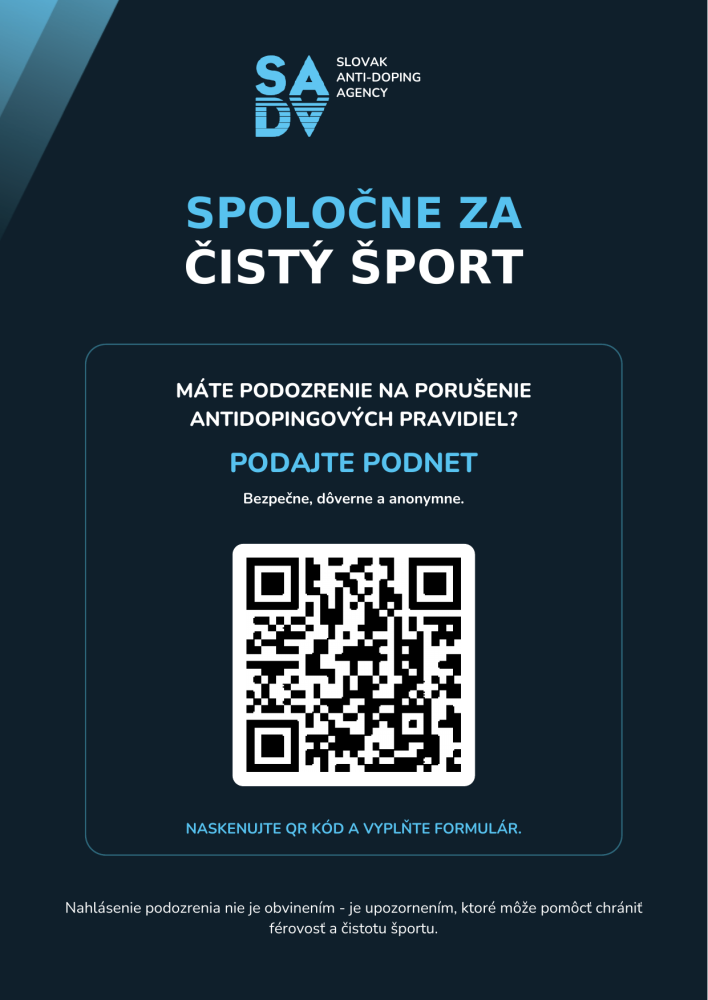
Together for clean sport. Do you suspect a breach of anti-doping rules? Report it to the Slovak Anti-Doping Agency — safely, confidentially and anonymously.
Reporting a suspicion is not an accusation. It is a warning that can help protect fairness and clean sport. The form is in Slovak.
Integrity of sport
The integrity of sport means the principles that guarantee the natural uncertainty and unpredictability of the course and outcome of a competition, as well as equal rules and conditions for all participants before and throughout the competition. There are two main reasons why it is undermined: a financial one, when the wrongdoer is motivated by the prospect of easy money, and a sporting one, when the wrongdoer is motivated by the prospect of easy sporting success. Both turn a quality sporting contest into a cheap show.
The most common forms of undermining the integrity of sport are competition manipulation, corruption, conflicts of interest and blackmail. Under Act No. 440/2015 Coll. on Sport, protecting the integrity of sport is a basic duty of every athlete and every national sports federation. This effort is supported by a growing number of international sports organisations, which increasingly make membership and participation in competitions conditional on actively protecting the integrity of sport. Since 1 July 2025 the Slovak Anti-Doping Agency has joined this effort, taking steps in awareness-raising, education, prevention and the fight against these negative phenomena.
Incidents and indications of a breach of the integrity of sport, including suspected breaches, can be reported in person at the Slovak Anti-Doping Agency, by phone on +421 905 381 486 or by e-mail to integrita@antidoping.sk.